

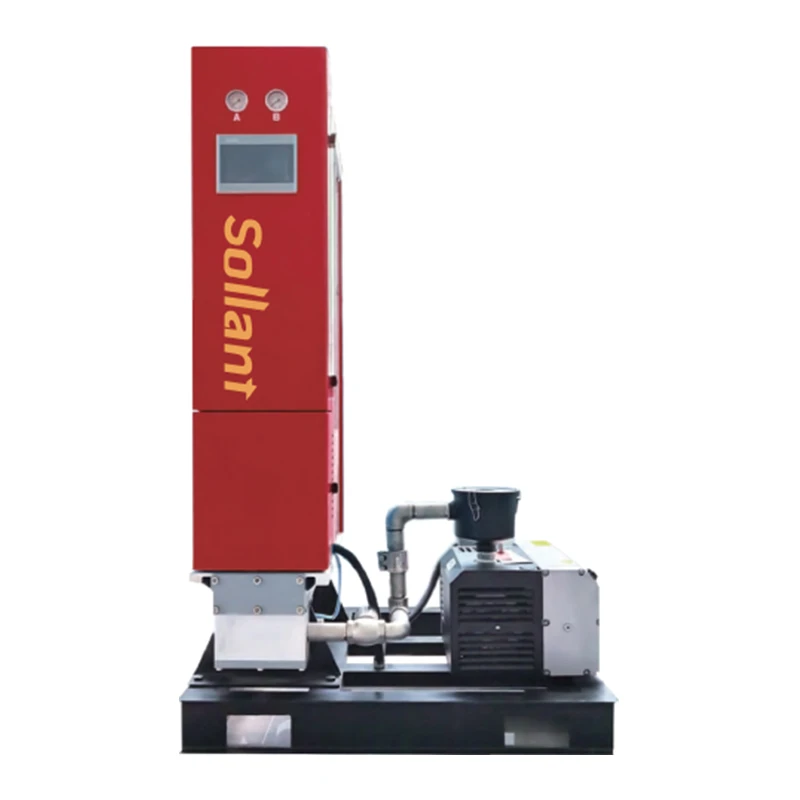
Product Overview
In the field of compressed air drying, energy consumption during regeneration is a major component of operating costs. Traditional adsorption dryers rely on significant amounts of processed compressed air for purge regeneration-often consuming 5% to 15% of the total throughput. Since this valuable air is vented directly to the atmosphere, it represents a substantial amount of "wasted effort" by the air compressor. In contrast, vacuum-regeneration adsorption dryers utilize negative-pressure technology; a vacuum pump extracts water vapor released from the adsorbent, eliminating the need for compressed air purging. This results in more thorough regeneration and superior dew points, enabling users to achieve lower overall operating costs while maintaining a high-quality air supply.
Product Features
Significant Reduction in Air Consumption
Utilizing vacuum-assisted regeneration technology, the system employs a vacuum pump to extract water vapor rather than using compressed air for purging. This reduces finished compressed air consumption by approximately 80% compared to traditional heated or heatless regenerative dryers, thereby significantly lowering air compressor load and energy costs.
Superior and Stable Dew Point via Thorough Regeneration
The boiling point of water drops significantly under vacuum conditions, making it easier for adsorbed moisture to desorb and release from the desiccant; this results in regeneration efficiency far surpassing conventional hot-air or atmospheric-pressure purge methods. More thorough regeneration leaves less residual moisture in the desiccant, ensuring full dynamic capacity recovery for the next adsorption cycle. This leads to a lower, more stable outlet pressure dew point with minimal fluctuation during long-term operation.
Fully Automated PLC Switching and Real-Time Data Display
Equipped with a standard Programmable Logic Controller (PLC), the system enables fully automated cyclic switching between adsorption and regeneration modes without manual intervention. A touchscreen panel displays key data-such as operating pressure, dew point temperature, and regeneration vacuum level-in real time, providing a clear overview of equipment status and ensuring intuitive, convenient operation. It also supports parameter settings and fault alarm logging, facilitating efficient maintenance and management.
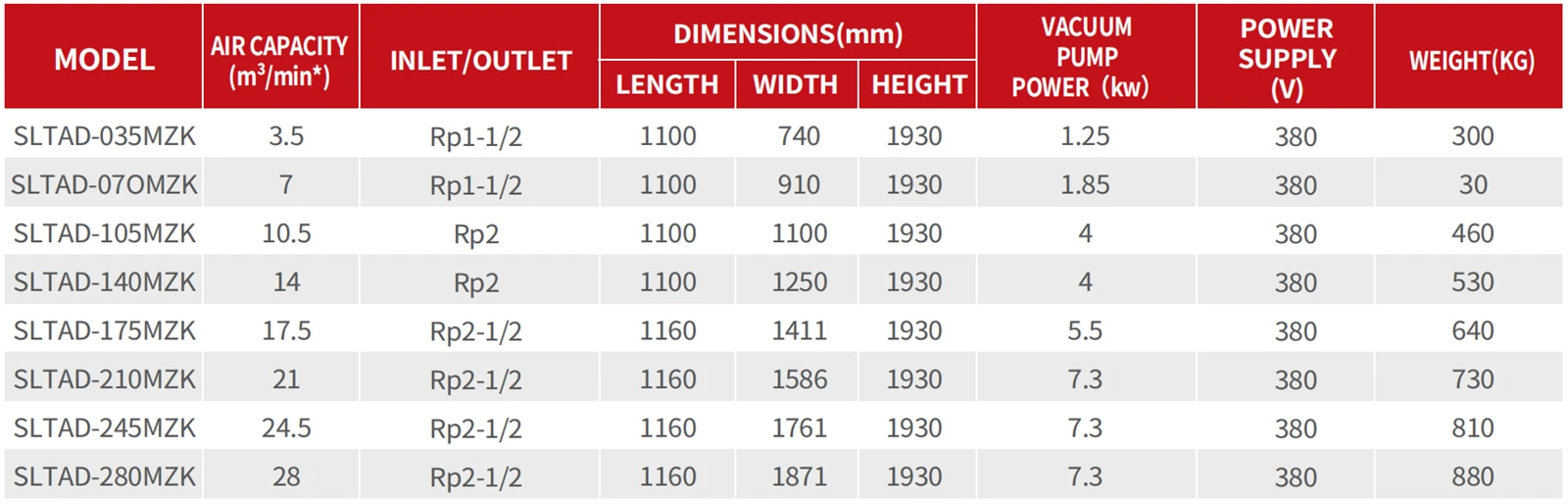
Technical Specifications for Vacuum Assisted Modular Desiccant Air Dryer
Application Scenarios
Electronics and Semiconductor Manufacturing
Meets extremely high requirements for dew point stability; low gas-consumption design reduces the overall energy consumption of cleanrooms.
Pharmaceuticals and Bioengineering
Complies with strict GMP standards for compressed air quality; operational data is recordable and traceable.
Food and Beverage Processing
Minimizes compressed air waste and reduces energy fluctuations caused by frequent air compressor loading and unloading.
Automotive and Precision Manufacturing
Stable dew point ensures the long-term reliability of pneumatic equipment and painting processes.
FAQs: Vacuum Assisted Modular Adsorption Dryer
Q1. What is the fundamental difference between vacuum regeneration and traditional regeneration methods?
Traditional heated or heatless regenerative dryers rely on processed compressed air-or a combination of electric heating and purge air-to remove moisture from the adsorbent; this consumes a significant amount of compressed air (typically 5%–15% of the processing capacity). In contrast, vacuum regeneration utilizes a vacuum pump to create a negative-pressure environment. This lowers the boiling point of water, facilitating easier vaporization and desorption, and the entire regeneration process consumes virtually no processed compressed air.
Q2. Does the vacuum pump require regular maintenance?
As the vacuum pump contains moving parts, it is recommended to regularly check the oil level and replace the lubricating oil and filter elements in accordance with the user manual. Specific maintenance intervals depend on operating hours and conditions; a detailed maintenance schedule is provided in the operation manual.
Q3. Does the oil content of the inlet air affect vacuum regeneration?
Yes, it does. Oil mist in the compressed air can contaminate the adsorbent and the vacuum pump, reducing both adsorption efficiency and pump performance. It is recommended to install a high-efficiency oil-removal filter upstream to ensure the inlet air oil content is ≤0.01 ppm.
Hot Tags: vacuum assisted modular desiccant air dryer, China vacuum assisted modular desiccant air dryer manufacturers, suppliers, factory, desiccant air drying system, desiccant compressed air drying unit, heatless adsorption dryers, rotary drum adsorption dryer, rotary drum desiccant air dryer for air compressor, Zero Loss Compression Heat Desiccant Air Dryer