

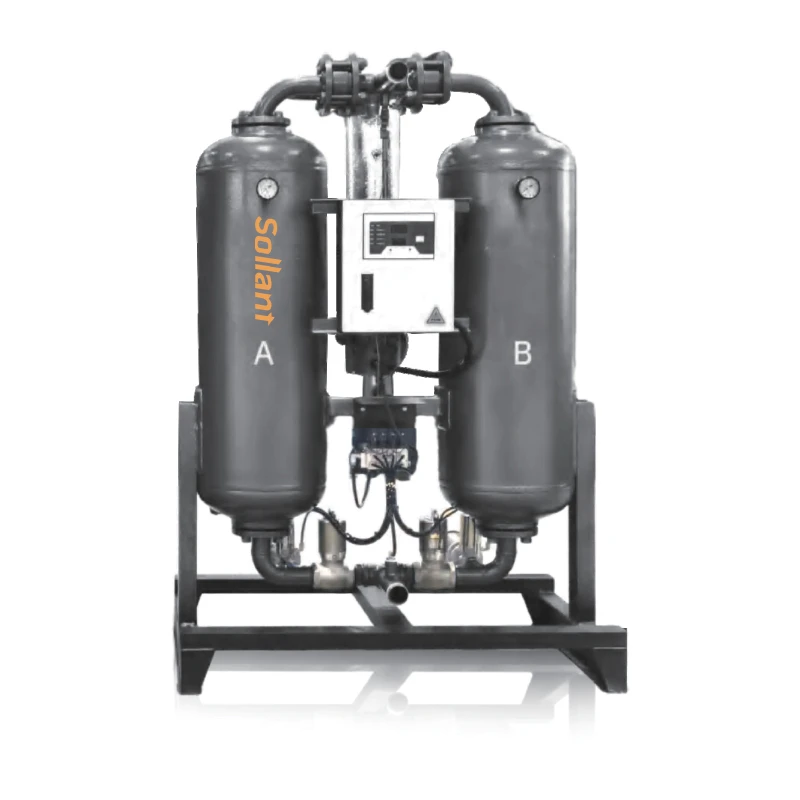
Product Features
Strict Manufacturing Standards
Designed, manufactured, and tested in strict accordance with ISO9001, GB150, ISO7183 (refrigerated dryer standards), QS, and pressure vessel inspection codes, ensuring safe and reliable operation. The adsorption tower structure and control program are optimally designed to ensure sufficient contact and interaction time between the compressed air and the adsorbent, achieving stable drying performance.
High-Quality Adsorbent and Filling Process
High-purity activated alumina and molecular sieves (meeting national standards) are selected as adsorbents. A vacuum filling method ensures a dense, uniform bed that resists pulverization and offers a long service life.
Safe and Reliable Adsorption Towers
The adsorption towers hold pressure vessel certification; every aspect-from materials to manufacturing-is strictly controlled to ensure safety.
High-Strength Heater
The heater features high mechanical strength, excellent pressure and electrical shock resistance, high heating efficiency, and superior insulation properties.
Intelligent Control System
Equipped with an intelligent controller that displays operating parameters in real-time; the system offers high control precision and stability, while facilitating easy cleaning and maintenance.
High-Performance Pneumatic Control Valves
Characterized by rapid response, long service life, and stable operation.
Low-Power Solenoid Valves
Standard-equipped with low-power-consumption solenoid valves that offer high precision and fast response speeds.
High-Efficiency Silencer
Utilizes a composite structure of multi-layer fibers and sound-insulating materials, combined with a unique mechanical noise-reduction design, to ensure low operating noise.
Heated Regenerative Desiccant Dryer Specification Table

FAQs About Heat-Regenerated Twin-Tower Adsorption Air Dryers
Q1: What applications are suitable for heated twin-tower dryers?
They are suitable for applications requiring a low compressed air dew point (pressure dew point of -20°C to -40°C) where on-site heating capabilities exist. They are widely used in industries such as precision manufacturing, spray painting, electronics, pharmaceuticals, food and beverage, and pneumatic instrumentation.
Q2: What is the difference between a heated twin-tower dryer and a refrigerated dryer? Which performs better?
Refrigerated dryers use refrigeration principles to cool the air and remove moisture, typically achieving a pressure dew point of +3°C to +10°C. Heated twin-tower adsorption dryers use adsorbents for deep dehydration, achieving dew points of -20°C to -40°C or lower; their drying performance is far superior to that of refrigerated dryers. However, heated twin-tower dryers incur regeneration energy costs, as they consume electricity to heat the regeneration gas and also require a small amount of purge air.
Q3: Does the regeneration process of a heated twin-tower dryer consume compressed air?
Yes. During regeneration, a portion of the dried product air is used as purge gas to carry away the water vapor released during desorption. Purge air consumption typically ranges from 5% to 8% of the total processed airflow (depending on the specific model).
Q4: What causes the outlet dew point to fail to meet requirements?
Common causes include:
- The adsorbent has lost effectiveness or is nearing saturation and requires regeneration or replacement;
- Excessive oil content in the inlet air has caused "oil poisoning" of the adsorbent;
- The regeneration temperature setting is too low or the heater has malfunctioned, resulting in incomplete regeneration;
- The switching cycle is improperly set, leading to an excessively long adsorption time;
- Inlet airflow or temperature exceeds design specifications;
- Insufficient purge airflow, preventing the complete discharge of regeneration exhaust gas.
Q5: Is significant pressure fluctuation during the twin-tower switchover normal?
Brief pressure fluctuations during switching are normal. However, if the fluctuation magnitude is excessive, possible causes include: the pressure equalization time is set too short, valve operations are uncoordinated, or a check valve has a poor seal. It is recommended to check the program settings and valve operation.
Hot Tags: heated twin tower desiccant air dryer, China heated twin tower desiccant air dryer manufacturers, suppliers, factory, desiccant dryer unit, heated twin tower adsorption dryer, heatless twin tower absorption dryer, micro loss blower heat desiccant type dryer, rotary drum adsorption dryer, rotary drum desiccant air dryer for air compressor